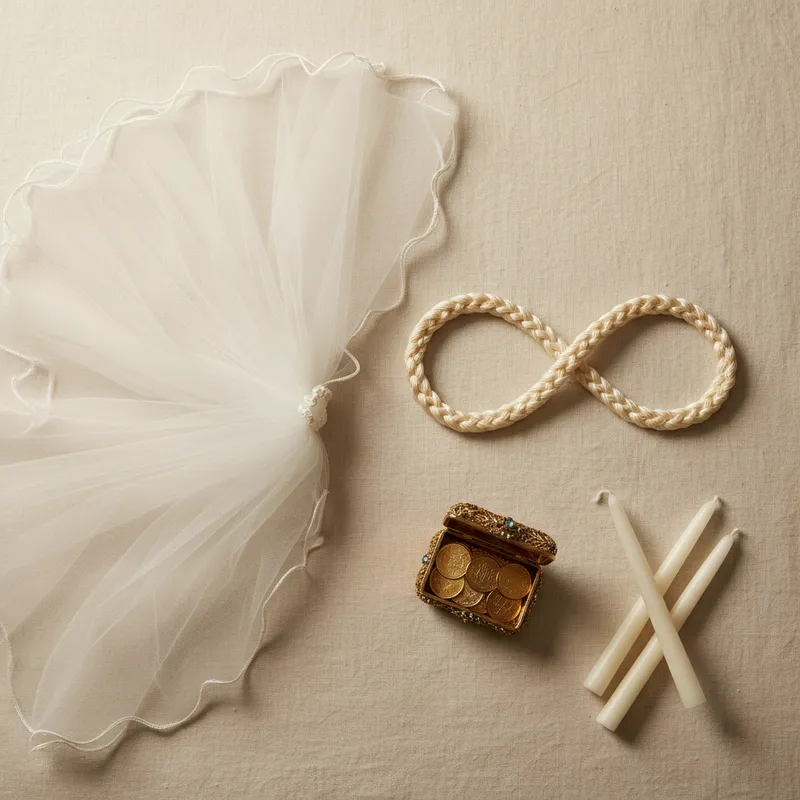
What Do the Cord and Veil Mean in a Wedding?
The cord in a wedding is a loop, often a braided rope, a rosary, or strands of flowers, laid in a figure eight over the couple to symbolize a bond with no end. The veil is a length of fabric pinned over the bride's head and the groom's shoulders, symbolizing two people clothed as one and sheltered together. In a Filipino ceremony they are placed by the cord sponsors and veil sponsors, usually a pair each, chosen from close family or friends. The coins and the candle complete the set of four rituals.
The cord, veil, coins (arrhae), and candle are four sacred rituals at the heart of a Filipino wedding ceremony. Together, they represent unity, protection, shared provision, and divine guidance. Promises made visible through action, not just words. In a Filipino wedding, the cord (yugal) symbolizes an infinite bond, the veil represents shelter and shared life, the 13 coins (arrhae) signify the couple's commitment to provide for each other, and the candle stands for God's guiding light over the new household.
These rituals are among the most meaningful moments of a Filipino ceremony. Whether you're planning a church wedding, a garden celebration, or just trying to understand what happens at a Filipino wedding, this guide explains each one: the meaning, the process, and the practical details you need to get it right.
The Veil (Belo)
A light mantle, usually white tulle, organza, or piña fabric, draped over both the bride and groom. The veil is placed on the bride's head and over the groom's shoulders, covering them as one.
What it symbolizes: Shelter, humility, and unity. The couple is "clothed as one" under the same covering, signifying that they will face the world together. It also represents the prayer that God will help them shoulder any burdens in their marriage.
Who places it: The veil sponsors (secondary sponsors), usually one person on each side. They gently drape the fabric and secure it with discreet pins or combs.
When it happens: After the exchange of vows, usually before or alongside the cord ceremony.
Practical tips:
- Choose a lightweight fabric. Heavy veils shift and distract
- Brief veil sponsors about hair placement and pin points during rehearsal
- If the bride has an elaborate updo, discuss pin placement with the HMU artist beforehand
- For outdoor weddings, secure both ends against wind
The Cord (Yugal)
A loop of material, traditionally silk, braided rope, a rosary, or flower strands, placed over the couple in a figure-eight shape, also known as the yugal. The infinity shape is deliberate.
What it symbolizes: An unbreakable, everlasting bond between the couple. The figure-eight represents infinity, a love that has no end. It also symbolizes their intertwined lives and mutual faithfulness.
Who places it: The cord sponsors (secondary sponsors). They loop the yugal over the heads and shoulders of the kneeling couple, forming the figure-eight.
When it happens: Immediately after or alongside the veil, while the couple is still kneeling. The cord stays on throughout the prayers and is removed after the final blessing.
Practical tips:
- Practice the figure-eight draping at rehearsal. It's trickier than it looks
- Choose a cord that's lightweight and flexible (avoid stiff rope or heavy beads)
- Cord sponsors should stand behind the couple, not beside them
- Regional variations: in the Visayas, some couples use woven inabel or locally crafted lasso styles
The Coins (Arrhae)
Thirteen coins, traditionally gold or gold-plated, presented by the groom to the bride. The officiant blesses the coins, the groom pours them into the bride's cupped hands, and she accepts them.
What they symbolize: The 13 coins represent Jesus Christ and his 12 apostles. They signify the groom's commitment to provide for the family and the bride's trust in receiving and managing their shared resources. More broadly, the arrhae represents stewardship, generosity, and the promise to share everything, for richer or for poorer.
Who presents them: The coin sponsor hands the arrhae to the officiant, who blesses them. The groom then takes the coins and pours them into the bride's hands.
When it happens: In Catholic ceremonies, the arrhae typically comes after the exchange of rings. Some officiants place it before the veil and cord; others after. Confirm the order with your parish priest.
Where to buy arrhae in the Philippines:
- Jewelry stores: Most jewelry shops in SM, Robinsons, or Divisoria carry arrhae sets (₱500 to ₱3,000)
- Heirloom sets: Some families pass down arrhae across generations. Ask your parents and grandparents
- Custom sets: Gold or silver custom-minted coins from local jewelers (₱3,000 to ₱10,000+)
- Online: Shopee and Lazada carry affordable sets (₱300 to ₱1,500)
Practical tips:
- Count the coins before the ceremony. Missing a coin mid-ritual is awkward
- Practice the "pour" motion at rehearsal (coins scatter easily)
- Bring a small box or pouch for safekeeping after the ceremony
- Some couples frame their arrhae as a keepsake after the wedding
The Candle
A lit candle, usually a pair of taper candles or a unity candle set, representing light and divine presence.
What it symbolizes: The light of God guiding the new household. The flame represents the couple's faith and the warmth of their new home together.
Who handles it: The candle sponsors. In some rites, the couple each holds a candle and lights a central unity candle together. In others, the sponsors light the candles and present them.
When it happens: This varies by tradition. In some Catholic ceremonies, the candle is part of the veil-cord-coins sequence. In some Christian (non-Catholic) ceremonies, the unity candle is the main ritual element.
Practical tips:
- For outdoor weddings: bring windproof lighters and glass hurricane sleeves
- Keep a backup lighter. Always
- If using taper candles, drip guards prevent wax on the couple's clothing
- Brief candle sponsors on safety: where to stand, how to hold, what to do if the flame goes out