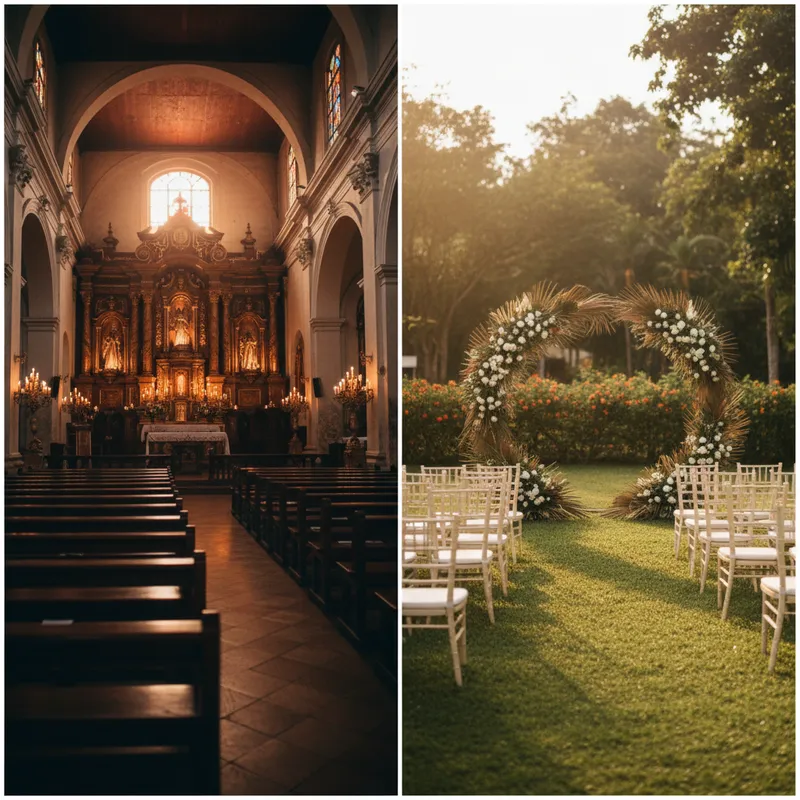
Church or Civil Wedding: Which Is Right for You?
It's one of the first big decisions after the proposal: simbahan o civil? Church or civil ceremony?
For many Filipino couples, this isn't just a practical question. It's deeply personal. Family expectations, religious beliefs, budget, and timeline all play a role. And the answer affects everything that follows: your document requirements, your costs, your venue options, and your planning timeline.
The short answer: a civil wedding takes 2 to 4 weeks to arrange and costs ₱1,500 to ₱35,000 for the ceremony; a church wedding needs 6 to 12 months and costs ₱25,000 to ₱95,000 for the full ceremony (the parish fee plus choir, aircon, coordinator, and flowers; the parish fee on its own runs about ₱5,000 to ₱45,000). Both are legally valid, both can be beautiful, and there's no wrong answer. Here's everything you need to know to make the right choice for your situation.
Civil Wedding in the Philippines
A civil wedding is a legal ceremony officiated by a judge, mayor, or other authorized government official. It's simpler, faster, and more flexible than a church wedding.
Document Requirements
You'll need to prepare:
- Marriage license. Apply at your local civil registrar. Processing takes 2 to 4 weeks. Valid for 120 days after issuance. See the full requirements at FilipiKnow's marriage guide.
- CENOMAR (Certificate of No Marriage). From the Philippine Statistics Authority (PSA). Can be requested online at PSA Serbilis. Processing: 5 to 10 business days.
- PSA birth certificates. For both parties. Must be PSA-issued (not local civil registrar copy).
- Valid government-issued IDs. For both parties (passport, driver's license, UMID, etc.)
- Community tax certificate (cedula). From your local barangay or municipal hall.
- Pre-marriage counseling certificate. A 1-day seminar required by law. Offered free at municipal offices and some churches.
- Parental consent. Required if either party is 18 to 20 years old.
- Parental advice. Required if either party is 21 to 25 years old.
For the full step-by-step civil process (where to apply, the 10-day posting period, and the week-by-week timeline), see our civil wedding requirements checklist.
Cost Breakdown
| Item | Estimated Cost |
|---|---|
| Marriage license | ₱300 to ₱500 |
| CENOMAR | ₱210 to ₱430 |
| Pre-marriage counseling | Free to ₱500 |
| Judge/mayor officiant fee | ₱500 to ₱3,000 (city hall) |
| Private venue officiant | ₱5,000 to ₱30,000 |
| Total ceremony cost | ₱1,500 to ₱35,000 |
The ceremony itself is very affordable. Your main cost is the reception, which is the same whether you go church or civil. See our complete wedding budget breakdown for reception costs, or our budget wedding ideas guide if you're planning it on ₱200K or less.
Pros of Civil Wedding
- Fast to arrange. Can be done in as little as 2 to 4 weeks
- Much cheaper ceremony. City hall weddings cost under ₱3,000
- Flexible venue. Garden, beach, restaurant, rooftop, your family home
- Short ceremony. 15 to 30 minutes
- No religious requirements. No baptismal certificate, no Pre-Cana, no banns
- Available to all couples. Regardless of religious background
- Multiple ceremony styles. Filipiniana, modern, minimalist, bohemian
Cons to Consider
- Some traditional families may not consider it "complete" without a church blessing
- No formal cord, veil, and coins ceremony (though some officiants incorporate these)
- Principal sponsors don't have assigned liturgical roles (though they can still participate)
Church Wedding (Catholic) in the Philippines
A Catholic church wedding is a sacramental ceremony, a religious rite, not just a legal formality. For many Filipino families, especially in predominantly Catholic communities, this is the expected and culturally significant choice.
Document Requirements (everything for civil, PLUS)
For the complete two-track checklist (the civil license plus the full canonical track) with validity windows and the rules for marrying outside your home parish, see our church wedding requirements checklist.
- Baptismal certificate. Must be a recent copy (within 6 months of the wedding date). Request from the parish where you were baptized.
- Confirmation certificate. Proof you received the Sacrament of Confirmation.
- Pre-Cana seminar certificate. A marriage preparation seminar required by the Catholic Church. Duration varies by parish: some offer 1-day, others require a 2-day weekend retreat. Typically ₱500 to ₱2,000 per couple. See our full Pre-Cana seminar guide for what to expect.
- Canonical interview. A private interview with the parish priest to discuss your readiness for marriage.
- Publication of banns. Your intention to marry is announced at Sunday masses for 3 consecutive weeks. This allows anyone with objections to come forward.
- Church reservation. Popular churches (Manila Cathedral, San Agustin, Sto. Domingo) book 1 to 2 years in advance. Less popular parish churches may have availability within 6 months.
Cost Breakdown
| Item | Estimated Cost |
|---|---|
| All civil requirements | ₱1,500 to ₱5,000 |
| Pre-Cana seminar | ₱500 to ₱2,000 |
| Church booking fee | ₱5,000 to ₱30,000 |
| Air-conditioning fee | ₱5,000 to ₱15,000 (if applicable) |
| Church coordinator | ₱3,000 to ₱8,000 |
| Choir | ₱5,000 to ₱15,000 |
| Church flowers/décor | ₱5,000 to ₱20,000 |
| Total ceremony cost | ₱25,000 to ₱95,000 |
Pros of Church Wedding
- Deeply meaningful. A sacramental covenant, not just a contract
- Culturally significant. Most Filipino families expect and honor this tradition
- Full ceremony rituals. Cord, veil, coins (arrhae), unity candle, and blessing
- Principal sponsors have formal roles. Ninong and Ninang stand as witnesses and mentors
- Grand, photogenic setting. Church architecture creates dramatic ceremony photos
- Community witness. The parish community is part of your celebration
Cons to Consider
- Requires 6 to 12 months minimum lead time (Pre-Cana, banns, church booking)
- More expensive ceremony (₱25,000 to ₱95,000 vs ₱1,500 to ₱35,000 for civil)
- Less flexible on venue and format
- Requires both parties to be baptized Catholic (or obtain special dispensation for mixed marriages)
- Some parishes have strict rules about decorations, photography, and dress code
Side-by-Side Comparison
| Factor | Civil | Church (Catholic) |
|---|---|---|
| Legal validity | Yes | Yes |
| Minimum lead time | 2 to 4 weeks | 6 to 12 months |
| Ceremony duration | 15 to 30 min | 45 to 90 min |
| Ceremony cost | ₱1,500 to ₱35,000 | ₱25,000 to ₱95,000 |
| Venue flexibility | Anywhere | Church only |
| Religious requirements | None | Baptism, Confirmation, Pre-Cana |
| Cord/veil/coins ritual | Optional | Included |
| Principal sponsor roles | Informal | Formal liturgical roles |
| Family expectations | Varies | Often expected |
| Dress code | Your choice | Usually formal (parish rules apply) |