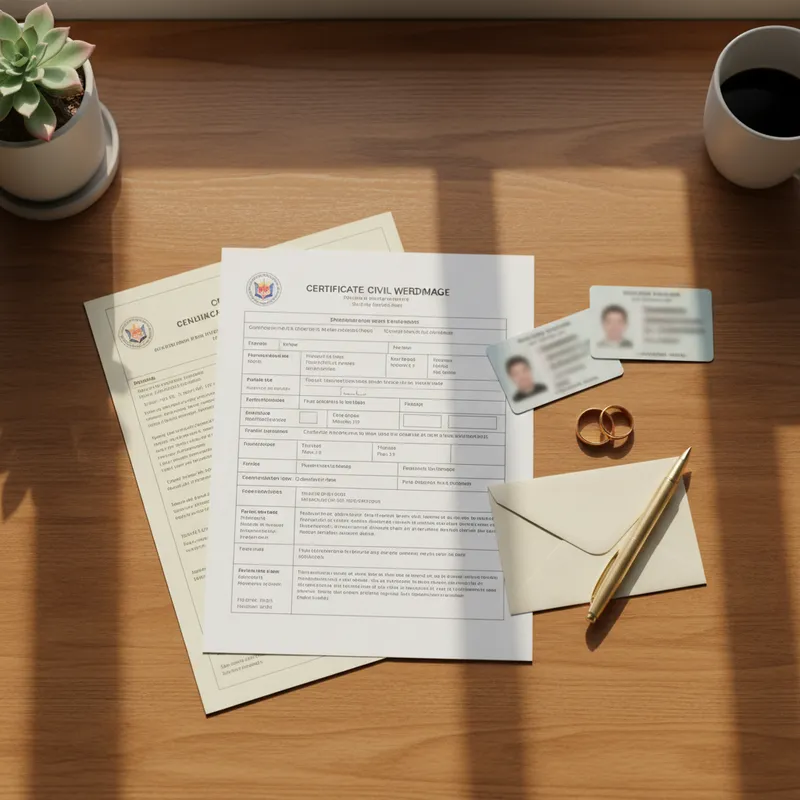
Civil Wedding Requirements in the Philippines (2026 Checklist)
A civil wedding in the Philippines requires a marriage license, CENOMAR, PSA birth certificates, valid IDs, a pre-marriage counseling certificate, and two witnesses aged 18 or older. Government and PSA document fees come to about ₱1,800 to ₱2,800 for the two of you, based on official fees in five cities, and the process takes about 3 to 4 weeks. Here's everything you need, step by step.
Civil weddings are the fastest, most flexible, and most affordable way to get legally married in the Philippines. Whether you're planning an intimate garden ceremony or a simple city hall wedding, this checklist covers every document, every step, and every cost, so nothing falls through the cracks.
Marrying in a Catholic church or under Muslim law instead? The document list is different. See our church wedding requirements checklist or Muslim wedding requirements checklist, and if your partner is of a different faith, the interfaith Muslim and Catholic guide. This page is the civil-only checklist.
Complete Document Checklist
Print this list. Check off each item as you go.
Required for Both Parties
| Document | Where to Get It | Cost | Processing Time |
|---|---|---|---|
| PSA Birth Certificate | PSAHelpline, the PSA's online channel, or a PSA outlet | ₱365 delivered | Next working day after release (Metro Manila), 3 to 8 working days elsewhere |
| CENOMAR (Certificate of No Marriage) | PSAHelpline online or a PSA outlet | ₱420 delivered, ₱210 walk-in at a PSA outlet | Next working day after release (Metro Manila), 3 to 8 working days elsewhere |
| Valid Government ID | Already on hand | N/A | N/A |
| Community Tax Certificate (Cedula) | Barangay hall or municipal hall | ₱5 plus ₱1 per ₱1,000 of income | Same day |
| 1x1 or 2x2 ID Photos | Photo studio | Varies by studio | Same day |
| Pre-marriage counseling certificate | Local Family Planning or population office | Free by law; some cities list related fees | 1 day (seminar) |
Additional Documents (Situational)
| Situation | Additional Requirement |
|---|---|
| Either party is 18-20 years old | Parental consent (signed by parents, notarized) |
| Either party is 21-25 years old | Parental advice (signed by parents, notarized). If there is no advice or it is unfavorable, the license is held for 3 months (Family Code, Article 15) |
| Previously married (annulled) | Court decree of annulment (PSA-annotated) |
| Previously married (widowed) | Death certificate of former spouse (PSA-issued) |
| Foreign national marrying a Filipino | Certificate of Legal Capacity to Contract Marriage from their embassy + passport |
Important notes:
- All PSA documents must be PSA-issued, not local civil registrar copies
- Birth certificates and CENOMAR must be recent. Some LCRs require within 6 months
- Order your PSA documents early. Online delivery takes 5-10 business days; walk-in at PSA outlets in SM malls is faster but may have long queues
Step-by-Step Process
Step 1: Gather Documents (Week 1)
Order your PSA birth certificates and CENOMAR online at PSA Serbilis. This is the fastest method. While waiting for delivery, get your cedula and ID photos done.
Pro tip: Both parties should order their documents simultaneously. If one person's PSA documents are delayed, it holds up the entire process.
Step 2: Attend Pre-Marriage Counseling (Week 1-2)
No marriage license is issued without a Certificate of Compliance, which Republic Act No. 10354, Section 15 says the local Family Planning Office issues for free. The session covers responsible parenthood, family planning, breastfeeding and infant nutrition, and takes half a day to a full day. Some cities list seminar or related fees in their license schedule, so ask your civil registrar what yours includes.
Where to attend:
- Your local Family Planning or population office
- DSWD-accredited counseling centers
- Some churches offer pre-marriage seminars that the LCR accepts
Note: This is different from Pre-Cana, which is a Catholic church requirement. The pre-marriage counseling for civil weddings is shorter (4-8 hours vs. 1-2 days) and non-religious.
Step 3: Apply for Marriage License (Week 2)
Visit the Local Civil Registrar (LCR) in the city or municipality where either party lives. Both applicants must appear in person.
What to bring:
- All documents from the checklist above
- Application form (available at the LCR office, or downloadable from some LGU websites)
- The license fees your city publishes. At the five offices we checked they run ₱250 to ₱952; see the city-by-city table
What happens at the LCR:
- Submit your application and documents
- Pay the application fee
- The LCR posts a Notice of Application for 10 consecutive days (this is a legal requirement under Article 17 of the Family Code. It allows anyone to file an objection)
- After 10 days with no objections, the marriage license is issued
The marriage license is valid for 120 days from issuance. You must hold your ceremony within this window. For a week-by-week view of when to start each document, see our marriage paperwork timeline.
Step 4: Choose Your Officiant (Week 2-3)
A civil ceremony is officiated by a judge or a mayor:
| Officiant | Fee | Where |
|---|---|---|
| Judge (huwes) | ₱300, fixed by the Supreme Court and paid against an official receipt (A.O. No. 125-2007) | Chambers or open court, within the court's jurisdiction |
| Mayor | Set by each city. Tagaytay's charter lists none; the City of Ilagan's lists ₱300 | Ask the mayor's office |
A judge may solemnize only "within the court's jurisdiction" (Family Code, Article 7), and a city or municipal mayor's power comes from the Local Government Code. For fees by city and what to ask each office, see our huwes and mayor wedding guide.
Ceremony outside city hall: a civil ceremony can happen at a garden, restaurant, beach or your family home if both of you request it in a sworn statement naming the place (Family Code, Article 8). Confirm with your officiant before you book the venue. A priest, pastor or minister can also marry you at their church, but that is a religious ceremony, and the Family Code requires at least one of you to belong to their church (Article 7).
Step 5: Prepare Your Witnesses
You need at least 2 witnesses who are:
- Of legal age, which is 18 or older (Family Code, Article 6; RA 6809)
- Present during the ceremony
- Willing to sign the marriage contract
These can be your principal sponsors (Ninong/Ninang), friends, or family members. For the full guide on choosing sponsors, read: Ninong & Ninang: Roles, Duties & How Many You Need.
Step 6: The Ceremony (Week 3-4)
A civil ceremony is short, typically 15-30 minutes. The officiant reads the legal provisions of marriage, the couple exchanges vows (the officiant provides a standard script or you can write your own), rings are exchanged, and the marriage contract is signed.
You can include Filipino traditions:
- Cord, veil, coins, and candle (these are cultural, not exclusively religious)
- Readings by family members
- Unity candle lighting
- Personal vows
For a complete guide on including these traditions, read: Cord, Veil & Coins Ceremony Meaning.
Step 7: After the Ceremony
After signing, the officiant sends the marriage certificate to the Local Civil Registrar for registration, not later than 15 days after the wedding (Family Code, Article 23).
Getting your PSA marriage certificate:
- The LCR forwards the marriage contract to PSA
- PSA processing takes 2-3 months
- You can request a copy via PSA Serbilis once it's encoded
- You'll need this PSA marriage certificate for legal transactions (passport update, bank accounts, property, etc.)