What to Wear to a Filipino Wedding: Reading the Dress Code
What to wear to a Filipino wedding comes down to one line: the dress code on the invitation. Strictly Formal means a gown or an elegant below-knee dress for women and a barong Tagalog or dark suit for men. Filipiniana calls for a terno, a Maria Clara, or modern Filipiniana for women and a barong for men. Semi-Formal or Garden Formal softens the fabrics and the hemlines. When you are unsure, match the formality of the invitation, dress for the venue and the heat, and stay off the couple's colors.
That is the short answer. The longer answer is where the anxiety usually lives, because a Filipino invitation can say "Strictly Formal," "Filipiniana," "Garden Formal," or "Semi-Formal (please, no white)," and none of those spell out what to actually put on. This guide decodes each code for guests, then covers what the entourage, the ninong, and the ninang wear, so nobody arrives over-dressed, under-dressed, or in a color they should have skipped.
Decoding the Dress Code on Your Invitation
Filipino weddings tend to run formal, and the couple usually signals how formal right on the invite (Bride and Breakfast). Here is what each common code means in practice.
| Dress code | Women | Men |
|---|---|---|
| Strictly Formal / Formal | Floor-length gown or an elegant below-knee dress | Barong Tagalog (piña or jusi) or a dark suit and tie |
| Filipiniana | Terno, Maria Clara, or modern Filipiniana separates | Barong Tagalog, ideally hand-embroidered |
| Semi-Formal / Cocktail | Cocktail dress or dressy separates | Barong or a long-sleeved shirt with slacks, coat optional |
| Garden / Beach Formal | Flowy dress in a light fabric, with block heels or wedges | Lightweight barong or a linen-blend shirt, no heavy suit |
Two rules cut through most of the confusion. First, match the formality of the invitation rather than guessing. If it says Strictly Formal, err toward more formal, not less. Second, keep your shoulders covered for a church ceremony even if you plan to relax the look at the reception (Nuptials). A shawl or a bolero solves that in seconds.
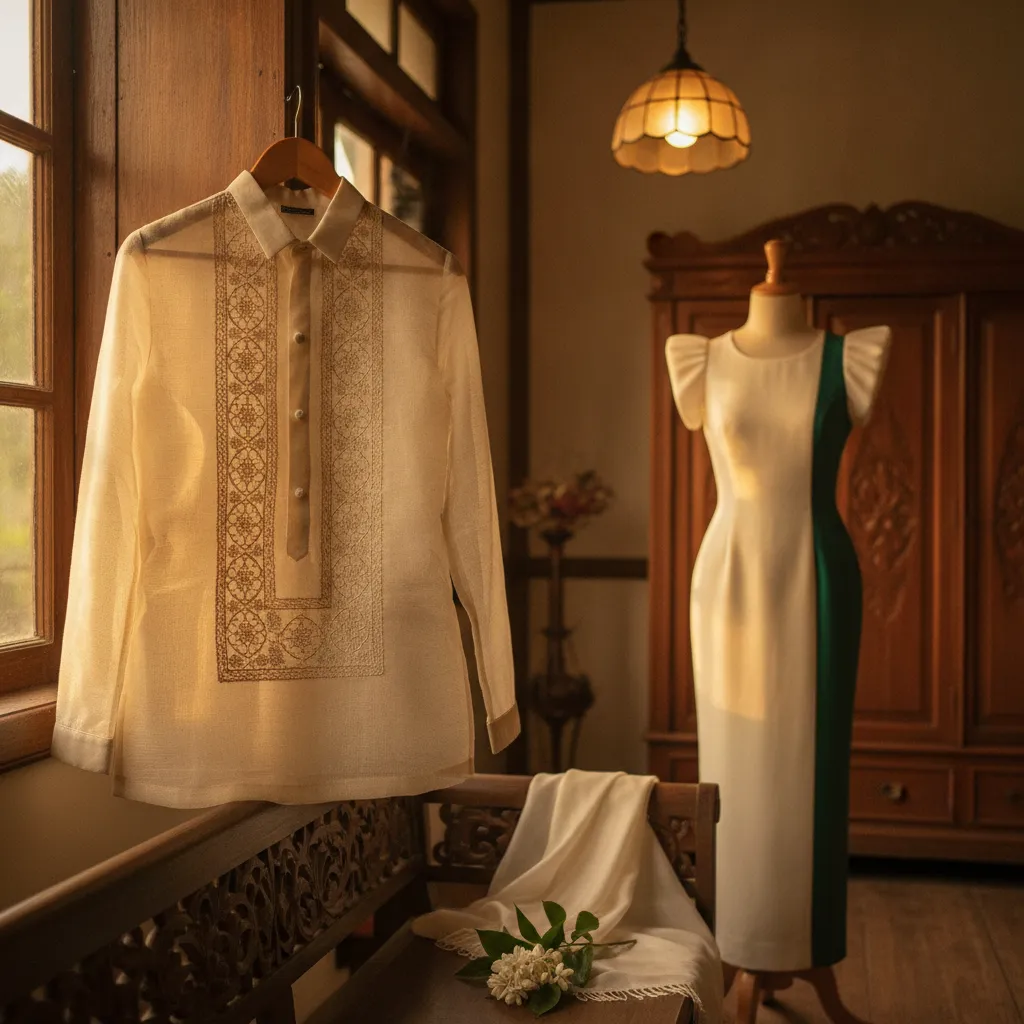
If the invite simply says Filipiniana, the couple is asking guests to celebrate Filipino heritage in what they wear. Women often reach for a terno with its signature butterfly sleeves or a Maria Clara, and men wear a barong. You do not need a custom piece to honor the theme. A modern Filipiniana top or a barong-style dress reads perfectly well (filipinowedding.com).
Dress for the Venue and the Weather
The venue tells you as much as the dress code does. A cathedral, a garden, and an evening ballroom each ask for different fabrics, and the Philippine heat makes fabric choice a comfort decision, not just a style one. Breathable materials like piña, jusi, chiffon, crepe, and light satin drape well and hold up in humidity (Kultura Filipino).
| Venue | What works | Watch out for |
|---|---|---|
| Cathedral or church | Structured terno, silk mikado, covered shoulders | Bare shoulders during the rite; pack a shawl |
| Garden or beach | Breathable piña, chiffon, or linen; block heels | Stilettos sink into grass and sand; skip heavy fabrics |
| Hotel ballroom (evening) | Satin, crepe, a suit or a structured gown | Overheating outdoors, then a cold aircon indoors; layer |
For an outdoor afternoon in the dry season, lean light and airy. For an evening reception in a hotel, you can go richer with fabric and structure. If the wedding runs from an outdoor ceremony into an indoor party, dress for the warmer half and bring a light layer for the cooler one.
What Guests Should Wear (and the "No White" Question)
As a guest, your job is simple: look put-together, respect the formality, and let the couple stand out. That last part is why so many Filipino invitations include a color note.
Avoid white and anything close to it (ivory, cream, pale champagne) unless the couple specifically asks guests to wear it. White is the couple's lane. Many invitations also list the entourage or motif colors and ask guests to steer clear so the wedding party stays distinct in photos (Bride and Breakfast). This is not the couple being controlling. It is a small courtesy that keeps their photos looking the way they planned.
A few more guest notes that keep you comfortable and appropriate:
- Black is fine at a Filipino wedding. It reads as elegant, not somber, especially in the evening.
- Denim, shorts, and flip-flops do not belong at a formal or semi-formal wedding, even a beach one. A beach wedding still means "beach formal," not "beach day."
- When the code is vague, dress one notch up. It is easier to relax an outfit (remove a jacket, change shoes) than to formalize one on the spot.
If you are a guest who also happens to love the Filipiniana look, a barong or a modern Filipiniana piece is welcome at almost any Filipino wedding, theme or not, because the barong is national formal wear. Our Filipiniana wedding theme guide breaks down terno, Maria Clara, and barong styles if you want to lean into that direction.
What the Entourage Wears: Echo, Not Uniform
If you are in the entourage, the goal is to look coordinated with the couple, not identical to each other. The strongest 2026 entourage looks echo the couple's palette and fabrics while letting each person keep a bit of their own silhouette (EventNest). Matching the exact same dress on everyone is no longer the only way to look cohesive.
| Role | Common attire cue |
|---|---|
| Bridesmaids | Echo the couple's palette; coordinated separates or dresses, not carbon copies |
| Groomsmen | Matching barong in the same fabric and shade |
| Flower girl / ring bearer | Mini versions that nod to the entourage look |
| Ninang (principal sponsor) | Elegant terno or formal dress in a complementary color |
| Ninong (principal sponsor) | Barong Tagalog, dressed with prominence |
The practical move for the couple: share your palette and fabric preference with the entourage early, ideally several months out, so everyone has time to have pieces made or sourced without a last-minute scramble. For picking that palette in the first place, our guide to wedding color palettes for Filipino weddings walks through combinations that photograph well in local light.
Modern entourage pieces also solve the day-long comfort problem. Terno tops with detachable butterfly sleeves let a bridesmaid look traditional for the ceremony and free her arms for the dance floor later. That kind of small, personal adjustment is exactly the point: coordinated on the outside, still yourself underneath.