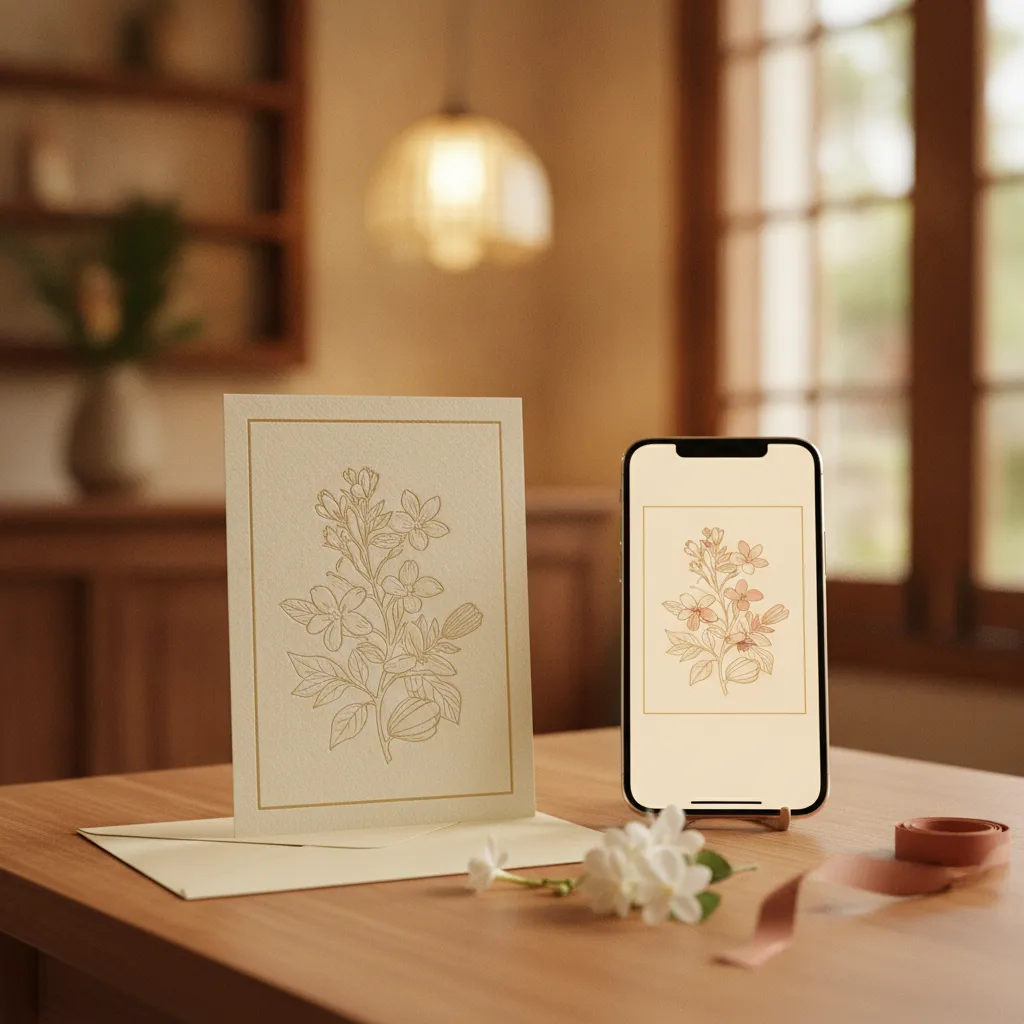
Digital or Printed Wedding Invitations: What Filipino Couples Actually Do
For most Filipino couples in 2026, the answer to digital vs printed wedding invitations is not one or the other. It is a hybrid: a digital invitation for the majority of your guests, plus a small batch of printed invitations for your principal sponsors, parents, and elder relatives. Digital handles speed, cost, and reaching guests abroad. Printed handles respect, keepsake value, and the titos, titas, and lolos who still expect paper in their hands.
That single decision (who gets paper, who gets a phone message) shapes your budget, your RSVP rate, and how your family feels about the whole thing. Here is how to make it without offending anyone.
Digital vs Printed Invitations at a Glance
Each format does a different job. Comparing them side by side makes the trade-off clear:
|
Digital invitation |
Printed invitation |
| Cost |
Close to free once designed |
A real per-piece cost that grows with your list |
| Reach |
Instant, including OFW and abroad guests |
Needs hand delivery or mail |
| RSVP speed |
Faster (one tap to reply) |
Slower (guest has to act separately) |
| Formality |
Modern and casual, unless designed formally |
Traditional, weighty, impressive |
| Keepsake value |
Low (a file on a phone) |
High (a card people keep) |
| Best for |
Friends, colleagues, cousins your age, OFW relatives |
Principal sponsors, parents, Ninong and Ninang, elders |
The takeaway is not "pick the winner." It is "use each format for the guests it fits." That is the hybrid, and it is why most couples land there.
Why Most Filipino Couples Go Hybrid
Filipino weddings carry a family weight that Western invitation guides miss. Your guest list is rarely just your friends. It is your parents' compadres, your Ninong and Ninang, relatives from the province, and colleagues who expect a certain formality.
Going fully digital saves money and reaches everyone fast, but it can read as casual to elders who see a printed invitation as a sign of respect and importance. Going fully printed honors tradition, but it is expensive at scale, slow for guests abroad, and wasteful for the friends who will RSVP through a group chat anyway.
The hybrid gives you both. You spend on paper only where it matters, and you use digital for the bulk of your list where speed and cost win. It also lines up with a broader 2026 shift: Filipino couples are planning more intentional, personal weddings and are comfortable mixing modern tools with tradition rather than treating them as opposites (Camella).
Who Gets a Printed Invite, Who Gets Digital
You do not need to agonize guest by guest. Sort your list into a few buckets and the pattern falls into place:
| Guest type |
Recommended format |
Why |
| Principal sponsors (Ninong and Ninang) |
Printed, hand-delivered when possible |
They hold a place of honor in the ceremony |
| Parents and immediate family |
Printed |
Respect, and they often keep it as a memento |
| Lolo, Lola, elder relatives |
Printed |
Many do not use RSVP forms or e-invites |
| Close friends and barkada |
Digital |
They reply fastest through chat |
| Work colleagues |
Digital |
A clean, professional channel |
| Cousins and relatives your age |
Digital |
Comfortable with phones and forms |
| OFW and guests abroad |
Digital |
No mailing delay, no lost post |
A useful rule of thumb: if you would feel awkward handing that person a phone screen instead of a card, they get printed. Everyone else gets digital. This usually means a small stack of printed invitations (often just your sponsors, parents, and closest elders) and a digital invite for the rest.
Your printed count also depends on how big your list is in the first place. If your numbers are creeping past your budget, our guide to setting a wedding guest list limit in the Philippines shows how to hold the line with family kindly before you order a single card.
Are Digital Wedding Invitations Disrespectful? The Ninong and Lola Question
This is the real worry behind the format debate, so let us answer it plainly. A digital invitation is not disrespectful. Sending it carelessly is.
Digital invites are socially accepted in the Philippines in the right context, and least accepted among older relatives who almost always expect a physical card (EventNest). The disrespect people feel is rarely about paper versus phone. It is about care. A mass "forwarded" invite dropped into a group chat with no name feels thoughtless. A personal message addressed to the guest, sent thoughtfully, communicates the same care a card would.
So the fix is simple. Give your elders and principal sponsors the printed card they expect. For everyone else, send digital with a personal touch (more on that next). Nobody who matters ends up feeling like an afterthought.
Family customs vary by region and by household, so when in doubt, ask your parents who on their side would expect paper. That two-minute conversation prevents most of the tampo.
How to Send a Digital Invitation That Still Feels Personal
A good digital invite is not a JPEG blasted to 200 numbers. Treat it with the same care as a card:
- Address each guest by name. A message that opens with "Hi Tita Baby" lands completely differently from a forwarded image with no greeting.
- Send it through the channel they actually use. Viber and Messenger for relatives, a wedding website link for friends, email for colleagues.
- Make replying effortless. Pair the invite with a simple RSVP link or a scannable code that opens a short form. In the US, The Knot reports that about half of couples now add a QR code to their invitations or save-the-dates, up from roughly one in five in 2022. The Philippines has no published figure like this (UNKNOWN), but the same scan-to-reply habit is clearly showing up here.
- Include every detail a card would. Names of the couple, date, time, ceremony and reception venues, dress code, and how to RSVP.
Getting Filipino guests to actually reply is its own challenge, digital or not. Our full playbook on wedding RSVP tips for the Philippines covers the deadlines, follow-ups, and buffer seating that keep your headcount sane.
What Every Filipino Wedding Invitation Should Include
Whether it is printed or digital, a complete invitation carries the same core information:
- The couple's names, and often the parents' names, following your family's preference.
- The principal sponsors, listed if your family tradition includes them on the invite.
- Date and time, with a clear ceremony start.
- Both venues, ceremony and reception, with enough address detail to navigate.
- Dress code, stated simply (for example, "Formal, Filipiniana encouraged").
- RSVP instructions, with a deadline and a link, form, or number.
- A seat note if you are controlling numbers, such as "We have reserved ___ seats in your honor."
That last line quietly manages the "pwede bang may kasama?" problem before it starts. It is polite, and it is clear.
When to Send Your Invitations
Timing matters as much as format. Filipino weddings need more lead time than Western guides suggest, because guests decide late and families are large:
| When |
What to send |
| 6 to 8 months before |
Save-the-date (optional, but useful for peak season or long-weekend dates) |
| 8 to 10 weeks before |
Main invitations, printed and digital, with the RSVP deadline |
| 12+ weeks before |
Invitations for OFW and abroad guests who need to book flights |
| 3 to 4 weeks before |
Follow up with guests who have not replied |
If you want the full countdown from engagement to the aisle, our wedding planning checklist for the Philippines maps where invitations sit among your other tasks so nothing gets missed.
The Budget and Sustainability Angle
Printed invitations are one of the easier places to trim without anyone noticing, precisely because the hybrid lets you print fewer. You spend on the cards that carry weight (sponsors, parents, elders) and let digital cover the rest for close to nothing.
There is a greener side too. Digital-first invites cut paper, ink, and delivery, which suits couples who want a lower-waste wedding. We are keeping exact peso figures out of this guide on purpose, since invitation prices swing widely by designer, paper, and volume. For where invitations fit in your overall spend, see our Philippine wedding budget guide, where all figures are hedged estimated ranges rather than fixed quotes.
Frequently Asked Questions
Q: Are digital wedding invitations acceptable in the Philippines?
Yes, in the right context. They are widely accepted among peers, colleagues, and guests abroad, and least accepted among elders who expect a physical card. The safe approach is hybrid: printed for sponsors and elders, digital for everyone else.
Q: Do I still need printed invitations at all?
For most couples, yes, but only a small batch. Your principal sponsors, parents, and closest elder relatives are the ones who most expect a physical card. You can send everyone else a digital invite.
Q: How do I send a digital invite without it feeling cheap?
Address each guest by name, send it through a channel they use (Viber, Messenger, email, or a wedding website), and pair it with an easy RSVP link. Care, not paper, is what reads as respect.
Q: What should a Filipino wedding invitation include?
The couple's names, principal sponsors if your family lists them, date and time, both venues, dress code, and clear RSVP instructions with a deadline.
Q: When should we send our wedding invitations?
Around 8 to 10 weeks before for local guests, and 12 weeks or more for OFW and abroad guests who need to book flights. A save-the-date 6 to 8 months out helps for peak-season dates.
Start With Who You Two Are
The invitation is one of the first things guests see, so it should feel like the two of you, not a template. Once you are clear on your style and your priorities as a couple, choices like digital versus printed, formal versus warm, and simple versus detailed get much easier to make together.
Storia helps Filipino couples find that shared direction first, then bring it into the details: guest management, RSVPs, and the decisions that follow.
Discover your Wedding DNA. Free, no signup needed. Take the quiz
Sources: The Knot, Wedding QR Codes, EventNest, Digital Wedding Invitations in the Philippines, Nuptl, Digital Wedding Invitations Philippines, Camella, Wedding Trends in 2026. QR adoption figures are US survey data; the Philippine equivalent is not published. Prices and customs vary by vendor, region, and family.
Plan your wedding with clarity
Discover your Wedding DNA in 5 minutes. Free, no signup needed.
Take the Free Quiz